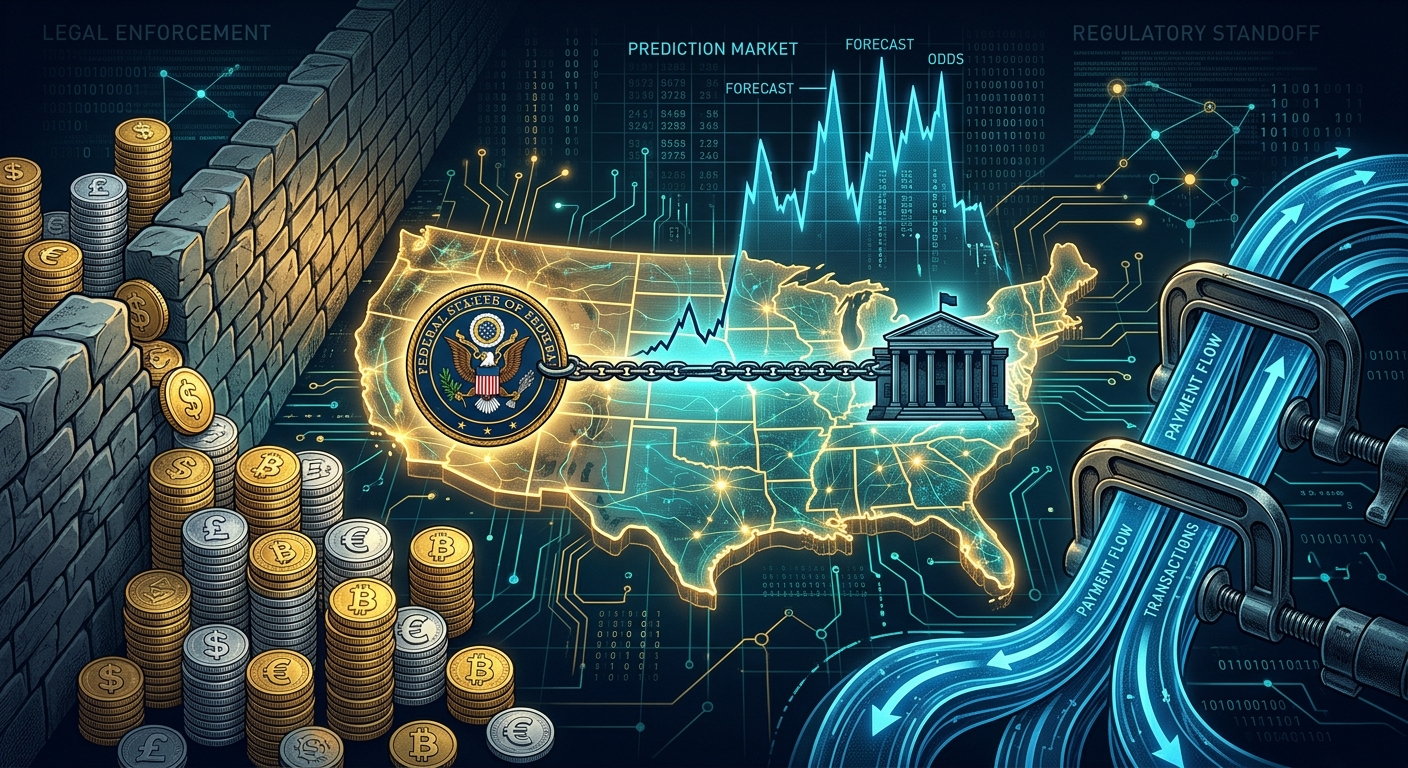
In August 2026, U.S. gambling enforcement focuses on three areas: sweepstakes casinos, prediction markets, and payment processors. States are increasingly banning the dual-currency sweepstakes model and suing processors to disrupt operations. Simultaneously, jurisdictional conflicts between federal and state authorities complicate the legal status of prediction markets across various states.
Enforcement primarily targets businesses rather than individual players, yet the shift creates a significant consumer protection gap. Offshore crypto casinos remain reachable but lack domestic regulatory oversight. Users should verify accounts early and use stablecoins as regulators increasingly target payment rails and advertising to curb unlicensed gambling activity.
The three fronts, in one page
US gambling enforcement in 2026 is running on three tracks at once, and the coverage tends to blur them together. They are separate, and only one of them is directly about crypto.
- Front one — sweepstakes casinos. The dual-currency “social casino” model is being legislated out of existence state by state. Eight statutory bans are in force, Oklahoma’s lands on 1 November 2026, and Florida escalated from legislation to litigation on 19 August.
- Front two — prediction markets. Kalshi and Polymarket are being sued by state after state on the theory that event contracts on sports are sports betting. The CFTC has taken the opposite position — forcefully. This is now a constitutional preemption fight, not a gambling policy debate.
- Front three — the payment layer. Cutting across both, regulators have discovered that suing the processor is faster than suing the operator. Louisiana wrote it into statute in May 2026; Florida put it into a complaint in August.
Offshore crypto casinos are not a direct target on any of these fronts. They are the thing all three fronts push players toward — which is why the market is watching this closely, and why we would rather you read a sober version of it than an affiliate one.
For the global picture — Curaçao’s licensing reform, MiCA, Brazil’s payment ban, Australia’s blocking programme — see our regulations tracker: crypto gambling regulation in 2026, jurisdiction by jurisdiction. This post stays on the United States.
Florida sues Stake, VGW — and their payment processors
On 19 August 2026, Florida Attorney General James Uthmeier filed two complaints in Hillsborough County Circuit Court. The defendants:
- Stake.us, operated by Sweepstakes Ltd, together with Stake’s co-founders Bijan Tehrani and Ed Craven.
- VGW and its brand entities — Chumba Casino, LuckyLand Slots and Global Poker.
- Payment processors, named as co-defendants rather than witnesses: Worldpay (and Worldpay Holdco), Trustly, Praxis and Breeze Labs. Some outlets also list Yodlee; the complaints have not been published in full, so treat the exact processor roster as unsettled.
The legal theory is the one Louisiana’s attorney general roadmapped in 2025 and that California codified in AB 831: the dual-currency structure is a distinction without a difference. You buy Gold Coins that have no cash value, you are given Sweeps Coins or Stake Cash alongside them, you play casino games, and the second currency converts to money. Uthmeier’s framing, quoted across the trade press, was blunter: “If it looks like a casino, takes real money like a casino, and pays out like a casino, it is a casino.”
The relief sought is aggressive — permanent injunctions barring Florida operations, forfeiture of player losses, disgorgement of profits, restitution, and civil penalties under Florida’s Deceptive and Unfair Trade Practices Act, reported at up to $10,000 per violation and $15,000 where an elderly or disabled consumer is involved.
Two caveats worth holding onto, because most coverage skipped them. First, this is a filing, not a finding — no court has ruled that these operators broke Florida law, and both companies have contested similar claims elsewhere. Second, the penalties target companies, not players. Nothing in either complaint creates liability for someone who bought a Gold Coin package.
What to do with this: if you hold a balance at a US-facing sweepstakes site, redeem it rather than letting it sit. The pattern across 2025–2026 has been the same each time a state moves — operators announce a wind-down date, and balances become an administrative problem for people who waited. Stake.us gave California players until 30 December before closing all game modes there; that was orderly, but it was also a deadline.
Stake.us is not Stake.com — why that matters
This trips up almost every reader, and the headlines do not help. Two different products share a brand family:
| Stake.us | Stake.com | |
|---|---|---|
| Model | Dual-currency sweepstakes (Gold Coins / Stake Cash) | Direct crypto-settled casino and sportsbook |
| Deposits | Card and bank purchases of coin packages | BTC, ETH, USDT, USDC, LTC, TRX and others |
| Licensing | Operates under sweepstakes/promotional law, not a gaming licence | Offshore gaming licence (Curaçao) |
| US availability | Marketed to US players, minus banned states | Not licensed for US players; geo-restricted |
| Named in the Florida suits | Yes | No |
The crackdown is aimed squarely at the left-hand column. The dual-currency model’s entire legal footing was that a “free entry method” made it a promotion rather than gambling, and state after state has now written that argument out of the statute books. The right-hand column has a different vulnerability altogether — it is unlicensed in the US and depends on players reaching it from jurisdictions where it does not hold permission. Different model, different risk, and conflating them leads to bad decisions in both directions.
The sweepstakes ban map: state by state
Here is the position as of 24 August 2026. Dates are the effective date where one is set, and the signing date where the law took effect immediately.
| State | Instrument | Status | Date |
|---|---|---|---|
| Connecticut | SB 1235 | Ban in force | 1 Oct 2025 |
| Montana | SB 555 | Ban in force | 1 Oct 2025 |
| New Jersey | A5447 | Ban in force | 2025, immediate |
| New York | S5935A (Ch. 605) | Ban in force | 5 Dec 2025 |
| California | AB 831 | Ban in force | 1 Jan 2026 |
| Indiana | HB 1052 | Ban in force — penalties to $100k/violation | 1 Jul 2026 |
| Maine | LD 2007 | Ban in force — targets dual-currency systems by name | Mid-Jul 2026 |
| Tennessee | SB 2136 | Ban in force via Consumer Protection Act | 22 May 2026 |
| Louisiana | HB 883 / HB 53 | Ban plus racketeering framework reaching processors, affiliates and software suppliers | May 2026 |
| Iowa | SF 2289 | Cease-and-desist powers granted to the Racing and Gaming Commission | 15 May 2026 |
| Oklahoma | SB 1589 | Enacted over veto — not yet effective | 1 Nov 2026 |
| Florida | Litigation, not legislation | AG suits filed against operators and processors | 19 Aug 2026 |
Bills failed or stalled in 2026 in Hawaii, Maryland, Massachusetts, Minnesota, Mississippi and Virginia, and several are expected back in 2027 sessions. Florida is the notable one: its bill died, and the attorney general went to court instead — which is precisely why the August filings matter beyond Florida. They demonstrate that a state does not need a sweepstakes statute to act.
A word on sourcing: state-by-state trackers disagree with each other on effective dates more often than you would hope, particularly where a law was signed in one year and phased in the next. We have used the dates that industry trade press and legislative records agree on, and flagged Oklahoma separately because it is the one that has not landed yet. If you are making a decision that depends on your specific state, check your state legislature’s own page rather than trusting any tracker, ours included.
Why processors became the target
This is the structural shift of 2026, and it is worth understanding properly because it explains what happens next.
Suing an offshore or offshore-adjacent gambling operator is slow. Service of process is difficult, corporate structures are layered across jurisdictions, and even a won judgment can be hard to enforce against an entity with no US assets. Regulators spent years learning this.
Payment processors are the opposite in every respect. They are large, regulated, US-facing businesses with banking relationships, compliance departments, and a strong preference for not appearing in an attorney general’s press release. They also sit at the exact chokepoint: no processor, no deposits; no deposits, no operator.
Louisiana made this explicit in statute in May 2026, extending liability to payment processors, affiliates and software providers under an anti-racketeering framework. Florida made it concrete three months later by naming four processors as co-defendants alongside the operators. Expect this to be copied, because it works — and note that “affiliates” appears in the Louisiana language, which is a category that includes review and comparison sites.
Here is the part that matters for readers of this site. Crypto rails do not have a processor to sue. A Bitcoin or USDT deposit from a self-custody wallet to an operator’s address does not pass through Worldpay or Trustly, and there is no US intermediary to enjoin. That is not a loophole anyone should feel triumphant about — it is a description of why regulators view crypto gambling the way they do, and why the pressure that cannot be applied to the rail gets applied elsewhere: to on-ramps under money-transmitter rules, to app stores, to advertising, and to ISP-level blocking in other jurisdictions. The chokepoint moves; it does not disappear.
Prediction markets: the federal-state standoff
The other US front is not a casino fight at all, but it will define what counts as gambling in America for the next decade.
The compressed version. Prediction markets like Kalshi and Polymarket list event contracts — including on sporting outcomes — under CFTC oversight as federally regulated derivatives exchanges. States say that a contract on who wins Sunday’s game is a sports bet, and sports betting is a state-licensed activity. Both positions have serious legal support, and 2026 has been a rolling collision between them.
What happened over the past eight weeks:
- 10 June 2026 — the CFTC published a proposed rulemaking (amending Regulation 40.11 and adding Appendix F to Part 40) setting out a framework for when event contracts touch activities the Commodity Exchange Act treats as contrary to the public interest, including “gaming.” It is a proposal, not a rule; it does not settle anything yet.
- 9 July 2026 — a federal judge ruled New York’s gambling laws do apply to Kalshi, cutting against an earlier Third Circuit decision that had gone the other way.
- 27 July 2026 — a different federal judge blocked Minnesota’s prediction-markets ban, finding the preemption argument likely to succeed. Two federal courts, opposite directions, same month.
- 31 July 2026 — New York Attorney General Letitia James sued Kalshi, alleging unlicensed gambling, tax evasion, and access for 18-to-20-year-olds below the state’s 21 minimum for mobile sports betting. The AG’s own release seeks treble damages without naming a figure; the widely reported “$36 billion” comes from press analysis of that treble calculation, not from the complaint’s face.
- 11 August 2026 — the CFTC invoked emergency authority under Section 8a(9) of the Commodity Exchange Act (Release 9281-26), ordering Kalshi to continue operating rather than shut down in response to state action. This is reportedly only the seventh use of that power in the agency’s history, and the first since 1980; every prior use involved physical commodity delivery crises in grain and silver.
- 13 August 2026 — a King County judge in Washington ordered Kalshi to stop offering sports, election, political and entertainment contracts in the state by 19 August, backed by penalties reported at $120,000 per day.
So a federal agency has ordered a company not to stop, and a state court has ordered the same company to stop. That is not a stable situation, and it is the reason this file will end up in front of appellate courts.
What to do with this: if you have been using prediction markets as a workaround for living in a state without legal online casinos, understand that you are standing in the middle of an unresolved jurisdictional fight, not in a safe harbour. Contract categories have been switched off state by state at a few days’ notice — Washington’s order gave six. Keep balances low and withdrawable.
Where did the displaced players go? An honest answer
Every affiliate site covering this crackdown — including some that compete with us — tells the same story: sweepstakes players are pouring into offshore crypto casinos. It is a tidy narrative and it is probably directionally true. It is also, as of today, mostly unevidenced.
What can actually be supported:
- The sweepstakes market was large. Eilers & Krejcik Gaming’s estimate of roughly $14.3 billion in Gold Coin package sales in 2025 is the figure most industry analyses build on, though we have seen it second-hand rather than in the primary report — treat it as an order-of-magnitude anchor rather than a precise number.
- 2026 is expected to be the segment’s first contraction year, on the combined effect of state bans and processors de-risking. That is a forecast, not a result.
- Operators have visibly exited states on schedule — Stake.us closed California at the end of December, and multiple brands pulled out of Indiana and Maine as those bans took effect.
What cannot be supported with public data: any specific claim about how many of those players moved to crypto casinos, or how much volume followed them. Offshore operators do not publish US-segmented figures, and nobody outside the operators has that number. When you see a confident percentage on this, it was estimated by someone with an incentive.
The defensible statement is narrower and still useful: a regulated-adjacent product with card deposits and US customer service is being removed in state after state, and the products that remain reachable are offshore, crypto-funded, and outside the reach of any US regulator that might help you. Whether that is a migration or a trickle, it is a downgrade in consumer protection for everyone who makes the move.
What this means if you play with crypto from the US
Enforcement is still aimed at businesses, not players
Across every action in this article — Florida’s complaints, the state sweepstakes statutes, the prediction-market suits — the defendants are operators, executives, processors and, in Louisiana’s language, affiliates. Penalties are framed per violation against companies. Prosecution of an individual player for using an offshore site remains vanishingly rare in the US. That is a factual observation about enforcement patterns, not legal advice, and it does not make an unlicensed site safe to use.
The consumer-protection gap is the real cost
The practical difference between a licensed and an offshore operator shows up exactly once: when something goes wrong. A voided withdrawal, a closed account with a balance on it, a bonus term applied retroactively. With a state-licensed operator you have a regulator to complain to. With an offshore one you have the licensing body — meaningfully better since Curaçao’s 2026 reform, but still not a US consumer agency. Price that in before you deposit, not after.
Verify early, withdraw often
Identity verification is now standard at licensed offshore crypto casinos, and it almost always bites at withdrawal rather than signup — which means the account gets flagged after you have won. Complete verification while you have nothing at stake. Our no-KYC casino guide covers the sites that still operate below verification thresholds and, more importantly, the trade-offs that come with them.
Stablecoins are the steadier rail right now
If the point of using crypto is the payment rail rather than the price exposure, holding a casino balance in BTC adds volatility you are not being paid for. Regulated stablecoins came inside the compliance perimeter across the major economies during 2025–2026, with reserve backing and redemption rights, which makes USDT and USDC the least legally awkward deposit asset available. See our breakdown of stablecoin casinos in 2026, and Lightning Network casinos if settlement speed is the priority.
Keep your own records
Chain analysis is now mandatory for licensed operators and tax authorities are increasingly able to request exchange data. Your gambling activity is more legible on-chain than it was two years ago. Keep deposit and withdrawal records; our guide on how to cash out Bitcoin walks through the cleanest routes back to fiat.
Geo-restriction is a contract problem before it is a legal one
Using a VPN is lawful in most places. Misrepresenting your location breaches nearly every operator’s terms, and detection has moved to the withdrawal review stage — the worst possible timing. The useful question is which operators’ policies actually tolerate it, which we cover in the VPN-friendly casinos guide.
What to watch between now and January
| Date | What | Why it matters |
|---|---|---|
| September 2026 | Senate floor vote on the CLARITY Act (digital asset market structure). A motion to proceed was filed 8 August; the chamber recessed without a vote. | Sets CFTC/SEC jurisdiction over digital commodities — the same agency boundary the prediction-market fight turns on. |
| Autumn 2026 | CFTC event-contract rulemaking moves from proposal toward a final rule. | Would define federally which event contracts are permissible — and sharpen or defuse the preemption clash. |
| 1 Nov 2026 | Oklahoma SB 1589 takes effect. | Ninth statutory sweepstakes ban; expect operator exit notices in October. |
| Ongoing | Florida v. Stake / VGW procedural milestones in Hillsborough County. | First real test of whether processor co-defendant liability survives a motion to dismiss. |
| Jan–Apr 2027 | New state legislative sessions in Maryland, Massachusetts, Ohio, Pennsylvania, Hawaii. | The stalled 2026 sweepstakes bills return; most mirror California’s AB 831 text. |
Frequently asked questions
Did Florida ban Stake in August 2026?
No — it sued. Two complaints were filed on 19 August 2026 in Hillsborough County Circuit Court against Stake.us, VGW and several payment processors, seeking injunctions, disgorgement and civil penalties. A filing is an allegation; no court has ruled. And the defendant is Stake.us, the US sweepstakes brand, not Stake.com, the offshore crypto casino.
Which US states have banned sweepstakes casinos?
Bans are in force in Connecticut, Montana, New Jersey, New York, California, Indiana, Maine and Tennessee. Oklahoma’s SB 1589 takes effect on 1 November 2026. Louisiana and Iowa passed enforcement-expanding laws in May 2026. Several other states’ bills stalled in 2026 and are expected back in 2027.
Are sweepstakes casinos the same as crypto casinos?
No. Sweepstakes casinos use a dual-currency model and claim promotional-law status rather than holding a gaming licence — that structure is what is being banned. Crypto casinos take direct deposits in Bitcoin or stablecoins and hold offshore gaming licences. Same industry, entirely different legal footing, and the crackdown targets the first model.
Why are payment processors being sued?
Because they are reachable and the operators often are not. Processors are US-facing regulated businesses sitting at the chokepoint between players and operators. Louisiana wrote processor liability into law in May 2026; Florida named Worldpay, Trustly, Praxis and Breeze Labs as co-defendants in August. Cutting the rail is faster than winning a judgment.
What is the Kalshi situation, in plain English?
New York sued Kalshi on 31 July 2026 for running what it says is unlicensed gambling. On 11 August the CFTC used a rarely invoked emergency power to order Kalshi to keep operating. On 13 August a Washington judge ordered it to stop offering several contract categories there. Federal and state authority are pointing in opposite directions, and no appellate court has resolved it.
Can US players still use offshore crypto casinos?
They generally remain reachable, and enforcement targets operators and payment infrastructure rather than individuals. But you get no US regulatory recourse if a withdrawal is voided or an account is closed, verification is now standard before cash-out, and geo-restriction breaches are a contractual risk that surfaces at withdrawal. Read the 2026 regulation tracker for what licensing actually guarantees before you choose an operator.
Does any of this make crypto gambling illegal in the US?
Nothing in the August 2026 actions changes the underlying position. There is still no federal crypto gambling framework; online casino gambling is a state matter; and offshore operators are unlicensed in every US state rather than newly banned by these cases. What changed is enforcement technique, not the legal status.
The bottom line
August 2026 was the month US gambling enforcement got good at its job. Rather than chasing operators across borders, states started naming the companies that move the money — and rather than arguing about product definitions, they wrote the dual-currency model out of the statute books entirely. Florida showed that a state does not even need its own sweepstakes law to act. Meanwhile the prediction-market fight has escalated into a genuine federal-state constitutional question, with a federal agency and a state court issuing directly contradictory orders to the same company in the same week.
For crypto players the practical takeaways are unglamorous and unchanged by any of it. The enforcement is pointed at businesses, not you. The thing you lose by playing offshore is not legality but recourse. Verify before you win, not after. Keep balances moving off the platform. And be sceptical of anyone — us included — who tells you with a straight face exactly how many players migrated where, because that number does not exist in public.
If you want the global rather than the US picture, start with our 2026 crypto gambling regulation tracker. If you are choosing where to play, our verified casino list only includes operators the BestCCO team has checked, licence and all.